The day was just like any other for a man and a boy in the woods. The noon sun warmed our faces, and the wind rustled the dried leaves on the ground. My son was probably too young to understand the significance as I zipped his blaze-orange vest and pulled his hat down tight. He liked to watch the dogs and throw rocks and climb trees—and that was enough for me.
As a dad, I felt like it was time to introduce him to the uplands. I believe that hunters have an inherent desire to ensure that their children enjoy the forests and fields in the future as we do now. Although I envisioned this being some grand ceremony—akin to a knighting with a sword—the day was just like any other for a man and a boy in the woods.
Success was not defined as having multiple birds in the bag. To be honest, no shells were ever loaded in my gun. My son learned the words “come” and “whoa” as the dogs cast about. He scratched his cheek on an aspen whip and scraped his knee sliding down a hill. He reached his short arms around my forehead while I carried him on my shoulders after his legs grew tired. My simple hope was that the smile on his face when we finished was just as big as it was when we began.
The last bend in the trail rounded an alder swamp that converged with ripe dogwoods on both sides. A dog bell had stopped chiming just out of sight, and my boy’s little legs could barely keep up as he followed my rush toward the silence. Just then, the abrupt and airy sound, trrrrrrrr, of a wary ruffed grouse left the scene straight away. “What was that?” he asked with wide-open eyes. We caught sight of the tail fan dodging alders to safety—a glimpse of time that lasted for maybe a second.
Fast forward to a couple years later: My son was following me on that same trail but in the light of the rising sun. He was noticeably older and taller and with a definite mind of his own. He carried a backpack full of goodies to distract him from time that he might describe as “boring.” The fact that I convinced him to go along was a minor victory for me in parenthood, but just as before, I felt an inherent need for him to experience the magic of an awakening springtime morning. We crept through the young poplars to the awaiting blind and settled in. Only minutes later, the crunching sound of small feet on the leaves of the forest floor could be heard getting louder with every step.
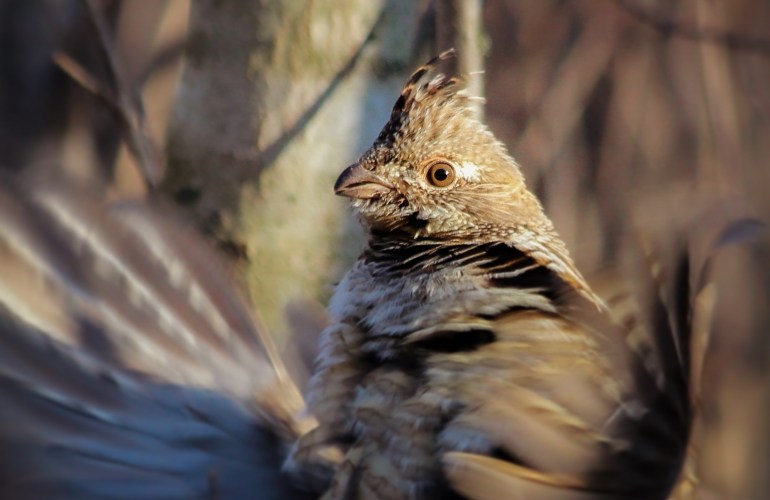
A proud grouse strutted toward the log with his tail fan stretched high and wide. He hopped onto his throne as if he was the king of the woods. Standing tall, his toes gripped the mossy log tight, and he began deliberately beating his wings, a motion that increased in frequency—creating a vacuum of sound similar to that of a tractor engine being started on a nearby farmstead.
Together, we watched that bird drum his beat for over two hours. Not even the pouring of coffee from the Thermos or the crackling of candy wrappers would disrupt his cadence. All the while, we enjoyed the throaty gobbles of turkeys, soaring wingbeats of ducks, and migrating melodies of songbirds. From only 20 yards away, we were captivated by a show that would trump any blockbuster at the movie theater or football game on the big screen any other day.
Observing a wild grouse for hours on end—when we only see them for mere seconds at the flush in the fall—is an opportunity to truly espy the surreal. I can’t help but believe that witnessing nature in its true form, like this, gives us a deepened appreciation for conservation of the wildlife we pursue. And even if in some small way, I’d like to think that this brief experience was a lesson, a gift of reverence and wonder, passed on to my descendants, too.
On the way home, my son admitted that the morning wasn’t as “boring” as he thought it might be, and I was glad for that, as the day was just as it should be—like any other for a man and a boy in the woods.
***
This is a short, true story that I wrote as an Editor Note during my time with Covey Rise Magazine. The photo was taken of a drumming ruffed grouse from that day.
 Matt Soberg