How our upland traditions can point new hunters in the right direction.
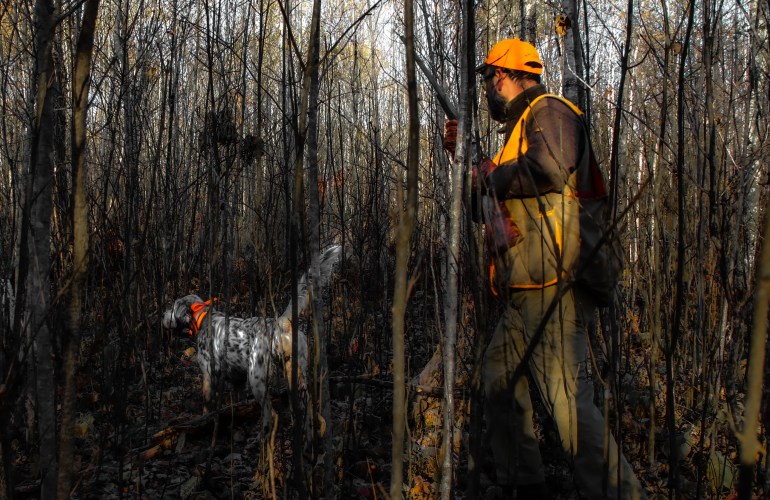
We arrived at a spot in the Northwoods that I had marked as “The Crossroads” on my plat book—an oasis of Minnesota public land at the intersection of two well-defined forest trails—one pointing due north and south with the other running straight east to west.
My hunting partner for the day was Zach, a young dad who I had met when our boys played summer baseball together. After talking at practice, I learned that he was an aspiring upland hunter, so I invited him on an October adventure to showcase the area’s potential for chasing grouse and woodcock. He grew up on a farm in Southern Minnesota, so shotguns were not new to him, but he was anxious to experience the challenges that the forest coverts could offer.
To start the hunt that day, we had parked the truck next to a brown, wooden “Hunter Walking Trail” sign with gold lettering that was proudly placed by the Department of Natural Resources. This particular trail, like many of its kind in the area, was a proverbial gateway to more afternoon action than any bird hunter could imagine if he or she put in some effort.
After a couple of hours in the woods and a few missed opportunities on pointed birds, Zach’s anxiety was getting the best of him. I could tell he was a bit discouraged, so we sat on a log at The Crossroads for a break. We had a decision to make: heading north meant a couple more hours of exploring new territory to prolong the hunt, or we could go south and back to the truck to end the day.
I pulled two sandwiches from my vest to share and took the opportunity to tell this hopeful new grouse hunter my infamous “The Study” story. I started:
“Libraries show status. The more books you have, the more sophisticated you are. Someday, I’ll have a huge library in my home that is stacked with books, all historical and such. My library will be adorned with the most ornate crown molding man can make with fancy woodwork, probably prize walnut from Turkey or something, trickling down the shelves to the ground. Books will be organized, not by name but by the color of their bindings—a regular rainbow of knowledge from end to end on every wall.
As you enter through the solid oak door with a sign reading “The Study,” you will see a fireplace in the back—always with two sleeping bird dogs warming themselves by the roaring flames. Nearby, a brown leather rocker will be my throne. The chair will be saddled by two tables within arms’ reach—one for the cigars and a pipe, and one for the bourbon, neat. I’ll spend hours on that throne, probably rereading New England Grouse Shooting by William Harnden Foster for the billionth time or writing my own epic novel of the uplands with only quill and ink—a bestseller for sure.”
“The Study” story keeps going for an annoyingly inordinate amount of time—I’ve been known to self-indulge in this tale at the tailgate after a particularly memorable hunt. It starts out tongue-in-cheek, if you didn’t already notice that, and I continue to wax poetic about how I garnered my love for upland classics with a desire to pass on these sporting traditions to the next generation. And that day with Zach, my story went on exhaustively long—the following is an abridged version of what I told him for your convenience.
***
My dad had a designated “study” in our house growing up—a “room of death” as my mom put it, because the walls were covered with sentimental trophies of big game and birds. Each had a story to tell, and . . . I’ve heard them all. There was a black gun safe in the corner for the firearms and valuables, and the coffee table housed our favorite hunting magazines and photo books. I spent countless hours in the room, dreaming that someday, just someday, I’d have a study of my own.
On a random Sunday afternoon when I was about 12 years old or so, and while thumbing through the photo books, I asked my dad about a faded, vintage image of him holding a couple of ruffed grouse. He looked quite young, maybe about the same age as I was at the time—the birds were held by their legs in one hand, what looked like an old single shot was in his other, and he had a big smile on his face. I pulled out the photo, and asked, “Dad, will you tell me about this hunt?”
“Hang on, buddy,” my dad replied. He stood up and approached the safe, entered the code, reached in, and pulled out that old 20-gauge single shot to show me. This was a Winchester Model 37 in pretty good condition, and he handed it to me.
As I admired this heirloom, my dad said, “I have a couple more things for you. I think now is the right time.” He pulled out the bottom drawer of the safe, rifled through its many contents, and picked up a couple of vintage treasures. One was an old, worn knife with a leather sheath—self-inscribed with “KAS,” which are my dad’s initials. The other was a simple, yet solid wooden box with a hinged top. When opened, the box revealed the most beautiful brass compass a boy’s eyes had ever seen.
“That photo shows the day that I shot my first birds with this gun, and now it is your turn,” my dad said. “I’ve had this knife since I was a kid. It’ll clean a pheasant or gut a deer, whatever you need,” he continued. “This compass has shown me the way through the mountains of Montana to the Northwoods of Minnesota. These are yours now. I’m passing them down to you.”
When you are 12 years old, I don’t think you realize the gravity of the lessons taught by others, but I do understand now—I shot my first bird with that same gun. The KAS knife has brought much meat to my table and an understanding that we honor wildlife by eating what we kill. The compass has shown me the way when I was lost, a time or two, and it has maybe the most important message for the future.
***
Back at The Crossroads, I reached inside my hunting vest and pulled out that very box to show Zach. With the top unhinged, I handed the compass to him to prove that the trail did, in fact, run due north to more miles of hunting or straight south and back to the truck. “This trusty little tool has shown me the way more times than I can count,” I said.
Zach held the compass in his hand and admired the intricate metalwork on the inside for quite some time. I kept talking, but he interrupted me with some reflections of his own—not about the lack of birds in his bag, but about how much he enjoyed my story, watching the dogs, learning about trees, hearing the birds flush, and how much he reveled in the sweet smell of gunpowder wafting through the air—even after a miss.
“You are lucky that your father passed on these traditions to you. Do you know that?” Zach remarked.
“I know. I know. I take it for granted,” I replied. “Which way do you want to go?”
“I see that your compass just so happens to always be pointing north, my friend,” Zach smirked. “I think it’s showing us the way, and I’m not one to argue. I’m not ready to be done yet, anyway . . . and next time, let’s bring the boys along too.”
~ Matt Soberg
First published in the Pheasants Forever Journal.
 Matt Soberg